
19 October 2026 · Guide
SEO built into every site
Every Lacuno site publishes as fast static HTML with titles, descriptions, a sitemap and language links, and tells search engines about every change on its own. Here is what Lacuno does for you, and what you set yourself.

Analytics without a cookie banner — Lacuno
Visitors, pages, sources and countries for every Lacuno site, updated every minute. No script, no cookie, no consent banner.
Each page sets its own title and description. The site's title template adds “— Lacuno”, and a social image fills the preview when someone shares the link.
- Reported to IndexNow · just now
- lacuno.io/blog/seoNew
- lacuno.io/de/blog/seoNew
- lacuno.io/blogChanged
- lacuno.io/de/blogChanged
New: IndexNow
Automatic submission to search engines
Every time a release goes live, Lacuno tells Bing, Yandex, Seznam, Naver and the other IndexNow search engines which pages are new, changed or removed. They no longer have to wait for their next crawl to find your changes.
- 1
You publish
As usual. There is nothing to set up: no key file, no plugin, no account with the search engines.
- 2
Lacuno compares
Every page is checked against the last release, so only real changes are reported.
- 3
Search engines are notified
The changed addresses go to IndexNow, which shares them with every participating search engine.
Google does not take part in IndexNow. It finds your pages through the sitemap, which Lacuno keeps up to date.
On every site
What every Lacuno site includes
Fast static HTML
Plain HTML on a CDN, with resized images and self-hosted fonts. Nothing has to load before the text shows.
Titles and descriptions
Per page, with one title template for the whole site and a social image for link previews.
Sitemap and robots.txt
Written on every publish. Pages you hide from search and the not-found page stay out.
Clean addresses
Readable paths, redirects for moved pages, and links that follow a page when you rename it.
One domain
HTTPS on your own domain. Your other hostnames and the lacuno.site address redirect to it, so search engines see one site.
Structured data
Add JSON-LD, such as an FAQ, to a page's head code. Our MCP page does exactly that.
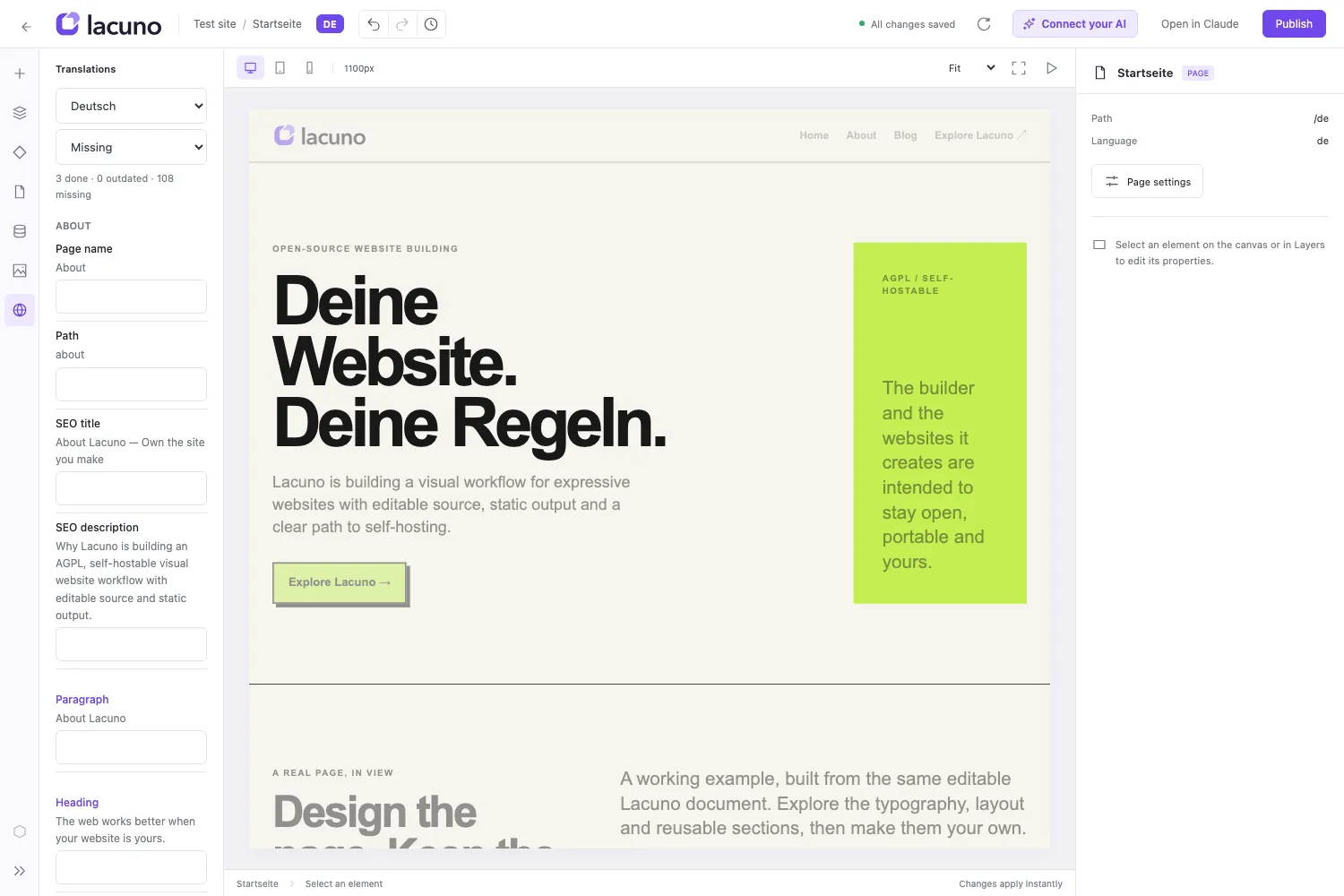
New: languages
Every language with its own address
German lives at /de/ueber-uns, with its own slug, title and description. Every page links its other languages, and the sitemap lists them all.
Translate in the editor, or let Claude or ChatGPT do it through MCP.
In every page head
The tags search engines read, written for you
Lacuno writes each page's language, canonical address and alternates into its head. This is our analytics post in German.
<html lang="de">
<link rel="canonical"
  href="https://lacuno.io/de/blog/analytics-ohne-cookie-banner">
<link rel="alternate" hreflang="en-US"
  href="https://lacuno.io/blog/analytics-without-a-cookie-banner">
<link rel="alternate" hreflang="de"
  href="https://lacuno.io/de/blog/analytics-ohne-cookie-banner">
<link rel="alternate" hreflang="x-default"
  href="https://lacuno.io/blog/analytics-without-a-cookie-banner">
With your AI
An SEO check by your own AI
Check every page's title and description and shorten the ones Google would cut.
Claude reads each page through MCP and fixes them in one batch, live on your canvas.
✓ Done
Start with a site search engines understand
Free to start. Everything on this page is included on every plan.